
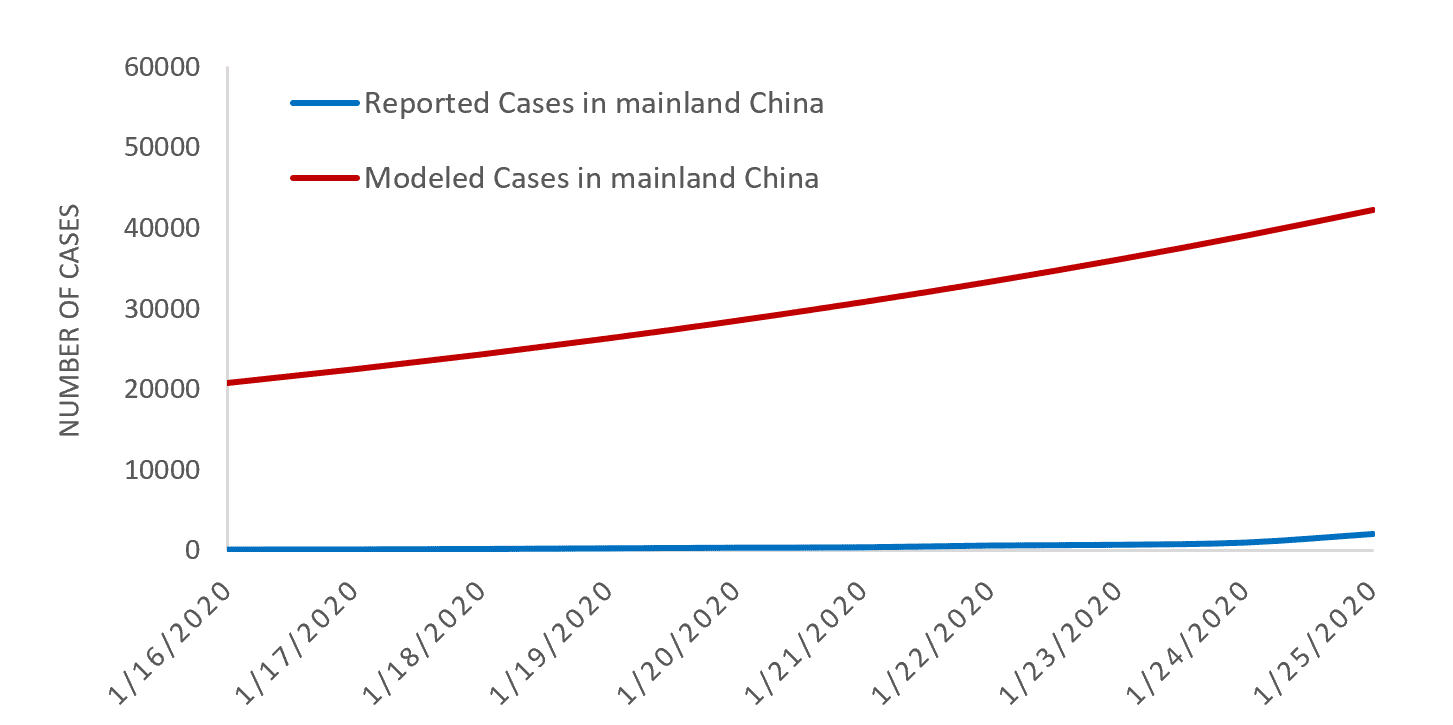
Figure 1. Estimated vs. Reported Cases of 2019 n-CoV cases globally.
The simulation provides the expected number of imported cases arriving at each airport globally (based on final travel destinations of travelers) as of Jan 25. By aggregating this over all airports in a country we can estimate the total number of imported cases in each country. Figure 2 below illustrates our estimated number of imported cases arriving in each country compared with the number of 2019-nCoV reported cases as of January 26. The results align with the number of air travel reported cases outside of mainland China early in the outbreak. Specifically, the 12 countries/regions we identify at highest risk have all reported at least one case.
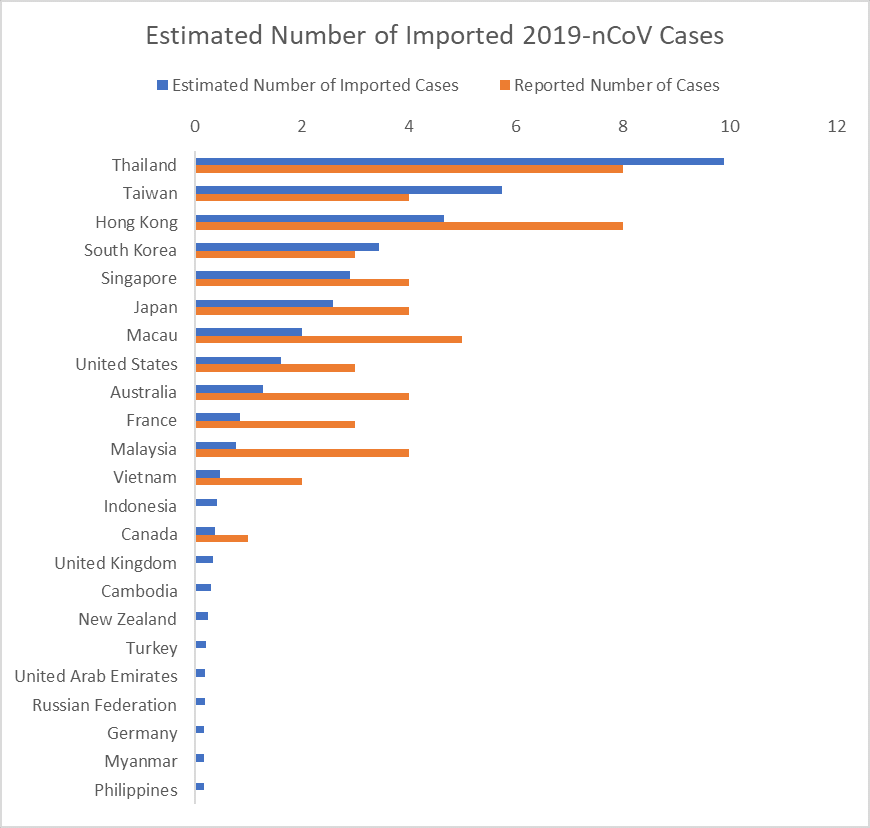
Figure 2. List of Countries/Regions with highest risk of imported 2019-nCoV cases.
We further present the results at the airport level (based on their final travel destination), to identify the set of cities inside and outside China at highest risk of case importation. The top 50 airports in China and outside of China are illustrated in Figure 3 and 4 below, respectively, and listed in Table 1 and 2 in the supplementary file. The cities at highest risk are generally those in China that receive high direct or indirect travel from WUH. While many of the cities outside China that we identify at high risk have already reported cases, these cities should be prepared for additional cases to be reported over the coming days, likely in travelers whom departed Wuhan before the travel ban was implemented on January 23. In the U.S., our high risk airports have already been designated for screening by the CDC, namely LAX, JFK, SFO, ATL and ORD. By considering complete travel paths (with stopover airports), we identify additional airports that are at risk of exposure to infected travelers, and suggest the international airports in Seattle, Washington-Dulles, Newark, Detroit, Boston, Houston, Las Vegas, Dallas Fort Worth and Honolulu in the U.S., also be considered for enhanced screening and security.

Figure 3. Map of the 50 Highest risk airports for 2019-nCoV arriving travelers within mainland China.
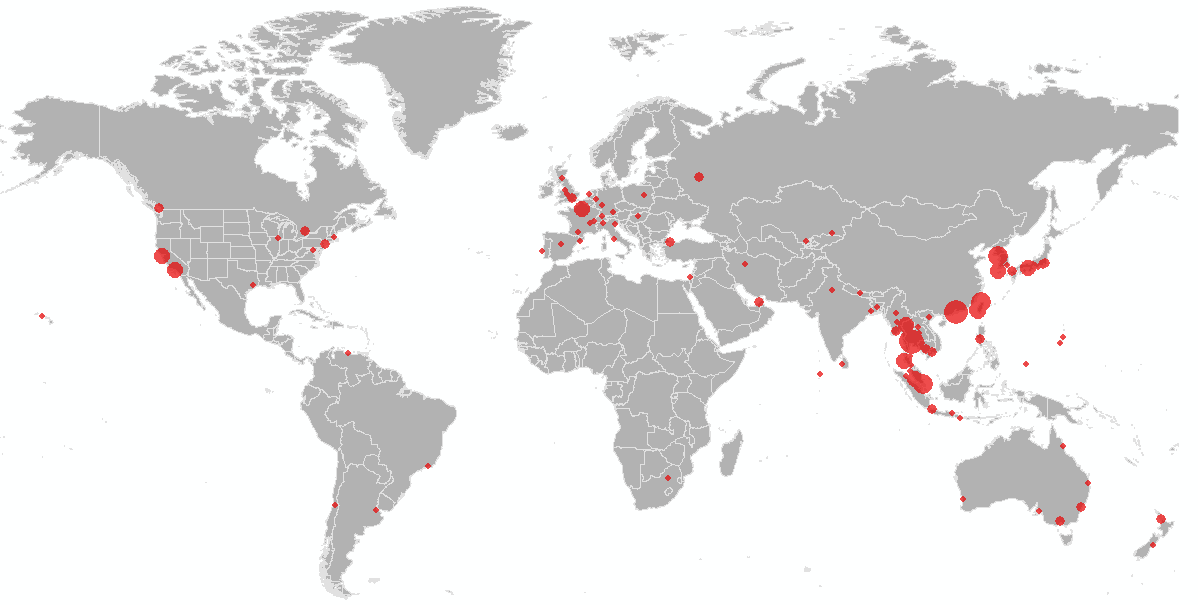
Figure 4. Map of the 50 Highest risk airports for 2019-nCoV arriving travelers outside mainland China.
Limitations
There are multiple modeling assumptions and limitations that should be noted regarding the results presented.
- In the day after this analysis was completed, travel reported cases increased by 40%, from 40 to 56. Therefore, it is likely the estimated number of cases reported in this study are a lower bound.
- There is still uncertainty about the transmission of 2019-nCoV, specifically surrounding the reproductive number and incubation period. The parameters chosen in this analysis fall in the uncertainty intervals provided to date. However, the substantial increase in cases being reported in late January indicate the parameters we used are too conservative, and the incubation period may be longer than we specified here, thus we are underestimating risk. More data will help us finer tune our estimates.
- Asymptomatic infections are not considered. If asymptomatic infections prove capable of spreading the virus, then these results would be further underestimating risk.
- The model only accounts for passenger air travel, and excludes mobility within and between cities via other modes of transport. Therefore, the spreading risk between regions connected via alternatives modes of travel is underestimated. This is most applicable to spread within China, which we are underestimating.
- The SEIR parameters used to model the outbreak within each city are deterministic. However, the spread of infected travelers moving between cities is modeled stochastically.
- Arrival passenger screening at airports and the complete air travel ban implemented in Wuhan on January 23 are not accounted for in this analysis. However, it is unlikely these policies impact the results presented, which are based on the start of the outbreak until January 25.
- No local control mechanisms (prophylaxtics, vaccines, school closures, quarantine efforts) within cities are accounted for. Thus, the reproductive number is assumed to be constant over time, and across all locations.
- We are using 2015 Travel data, because that is the most recent complete (airport-to-airport) data we had available in the lab.
Next Stages
The next stage of our modeling exercise will be forward looking, with two main points of focus. First, will be the identification of those travel routes likely to continue spreading 2019-nCoV cases around the world, assuming travelers are no longer departing Wuhan directly, and outbreaks are ongoing in multiple other cities in China. Second, we will identify the set of airports globally that should be prioritized for passenger screening.
Reference:
- Zlojutro, A, Rey, D and L Gardner*. (2019) “Optimizing border control policies for global outbreak mitigation”. Scientific Reports 9:2216. DOI https://doi.org/10.1038/s41598-019-38665-w (Open Source link) https://rdcu.be/bniOs