Utility Inference Under Uncertainty
Given an optimal or near-optimal solution, an inverse optimization problem determines objective function parameters of the forward optimization problem such that the solution becomes optimal for the forward problem. However, there is often uncertainty in the observed solutions and hence there is a need to develop robust inverse optimization models.
Assume that a decision-maker’s uncertain behavior is observed. We develop a an inverse optimization framework to impute an objective function that is robust against misspecifications of the behavior. In our model, instead of considering multiple data points, we consider an uncertainty set that encapsulates all possible realizations of the input data. We adopt this idea from robust optimization, which has been widely used for solving optimization problems with uncertain parameters. By bringing robust and inverse optimization together, we propose a robust inverse linear optimization model for uncertain input observations. We aim to find a cost vector for the underlying forward problem such that the associated error is minimized for the worst-case realization of the uncertainty in the observed solutions. That is, such a cost vector is robust in the sense that it protects against the worst misspecification of a decision-maker’s behavior.
As an example, we consider a diet recommendation problem. Suppose we want to learn the diet patterns and preferences of a specific person and make personalized recommendations in the future. The person’s choice, even if restricted by nutritional and budgetary constraints, may be inconsistent and vary over time. Assuming the person’s behavior can be represented by an uncertainty set, it is important to find a cost vector that renders the worst-case behavior within the uncertainty set as close to optimal as possible. Note that the cost vector can have a general meaning and may be interpreted differently depending on the application (e.g., monetary cost, utility function, or preferences). Under such a cost vector, any non-worst-case diet will thus have a smaller deviation from optimality.

A Combined Inverse Optimization for Personalized Diet

Data-Driven Inverse Optimization to Personalized Cancer Care
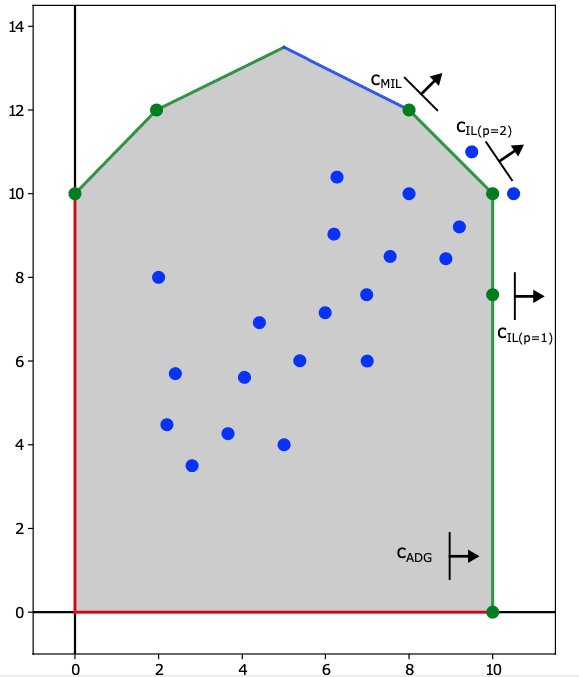
The medical decisions of experts, for instance the radiation treatment plan approved by oncologists, can be observed. However, the true underlying criteria based on which they approved or rejected a plan is not known. We develop data-driven inverse optimization models to infer the constraints parameters of an optimization problem to understand such expert-driven decisions better.
We develop a new inverse optimization framework to infer the constraint parameters of a linear (forward) optimization based on multiple observations of the system. The goal is to find a feasible region for the forward problem such that all given observations become feasible and the preferred observations become optimal. We explore the theoretical properties of the model and develop computationally efficient equivalent models. We consider an array of functions to capture various desirable properties of the inferred feasible region. We apply our method to radiation therapy treatment planning—a complex optimization problem in itself—to understand the clinical guidelines that in practice are used by oncologists. These guidelines (constraints) will standardize the practice, increase planning efficiency and automation, and make high-quality personalized treatment plans for cancer patients possible.

Inverse Learning: A Data-driven Framework to Recover Linear Optimizations