
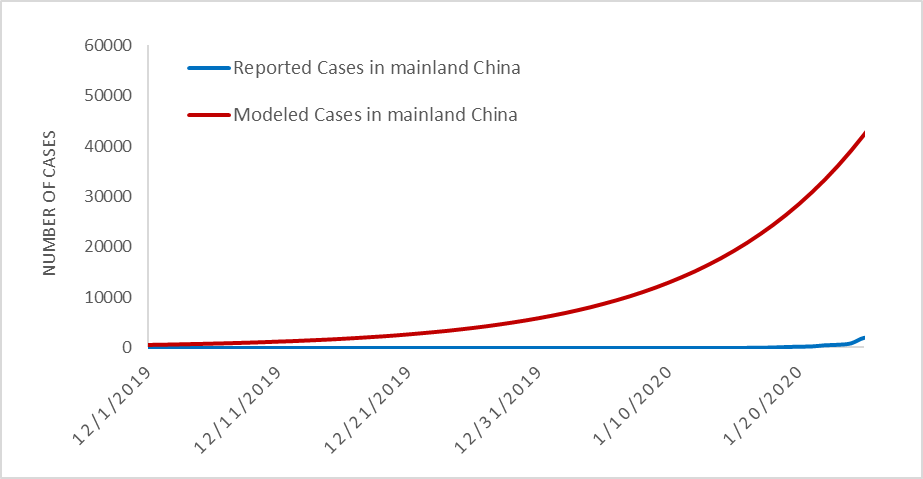
Figure 1. Estimated vs. Reported Cases of 2019-nCoV cases globally.
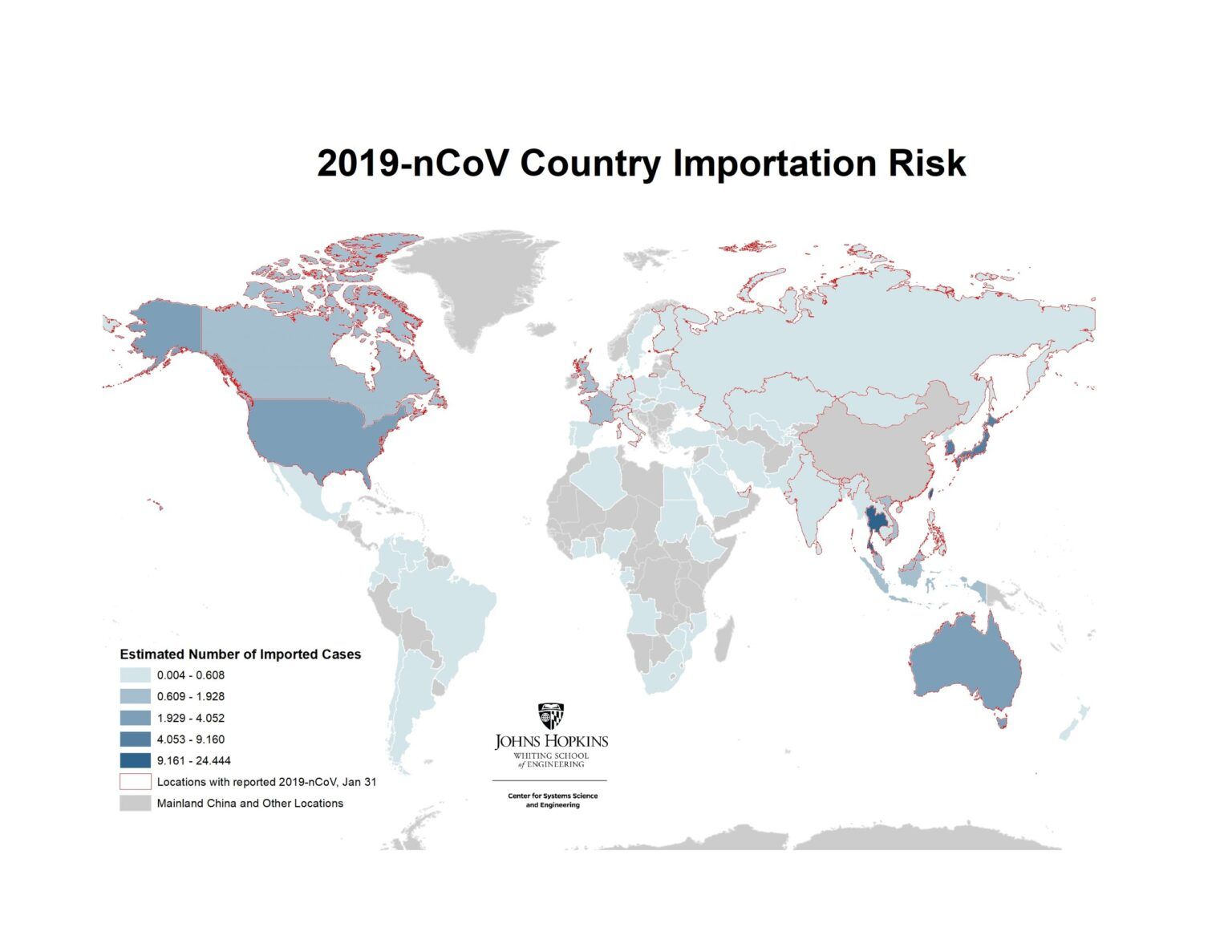
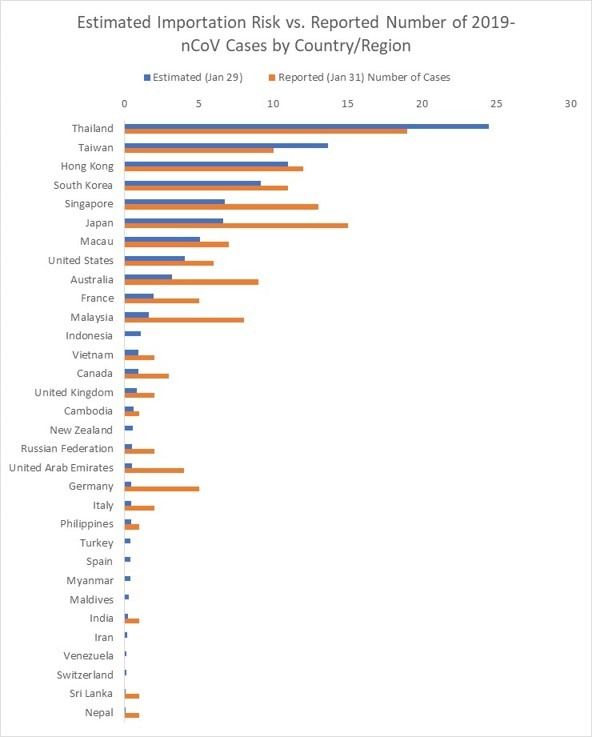
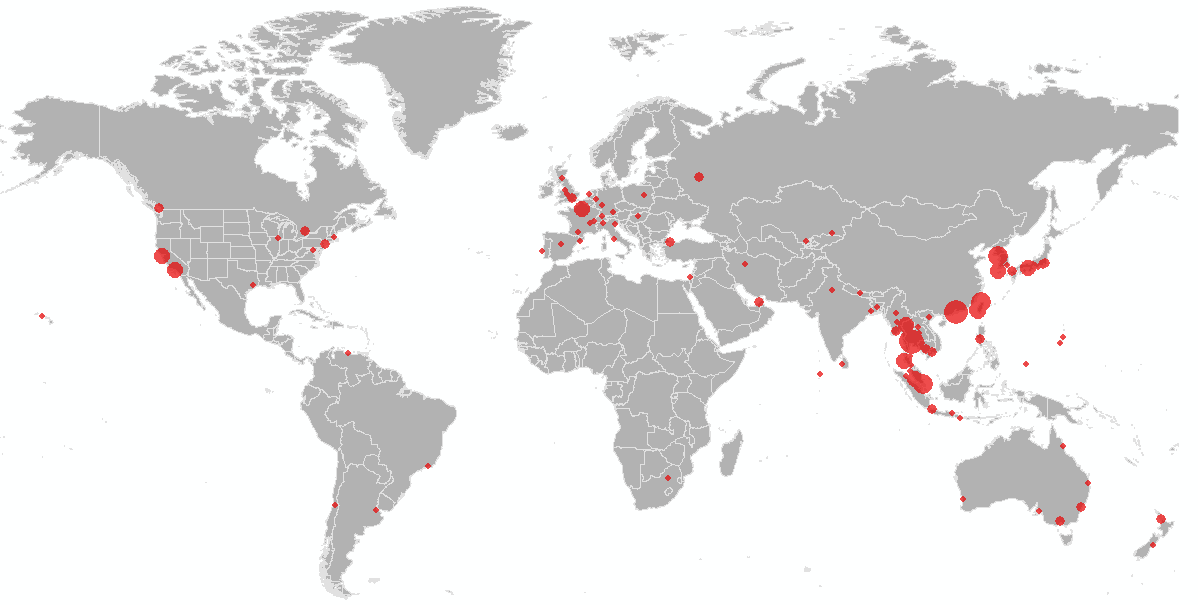
In addition to inferring the current outbreak size, the model provides the expected number of (the 100) imported cases arriving at each airport globally (based on final travel destinations of travelers). By aggregating this over all airports in a country/region we can estimate the total number of imported cases in each country/region. The country level importation risk is illustrated in the map in Figure 2, with the darker shades equating to higher importation risk, and the red outline indicating the set of countries reporting cases as of January 31.
Limitations
There are multiple modeling assumptions and limitations that should be noted regarding these estimates.
- There is still uncertainty about the transmission of 2019-nCoV. The parameters for the reproductive number and incubation period chosen for this analysis align with the best estimates to date. There is less known about the duration of the recovery period, which may be longer than the five days specified in this analysis. More data will help us finer tune our estimates.
- Transmission of infection from asymptomatic individuals during the incubation period, as was recently confirmed, is not considered in this analysis. It is therefore likely the number of reported cases outside of China will increase in the coming days, especially in those cities identified to be at highest risk in this analysis.
- The model only accounts for passenger air travel, and excludes mobility within and between cities via other modes of transport. Therefore, the spreading risk between regions connected via alternatives modes of travel is underestimated. This is most applicable to spread within China, which we are underestimating.
- The SEIR parameters used to model the outbreak within each city are deterministic. However, the spread of infected travelers moving between cities is modeled stochastically.
- Arrival passenger screening at airports and the complete air travel ban implemented in Wuhan on January 23 are not accounted for in this analysis. We are therefore likely overestimating the number of cases exported out of Wuhan during the last few days of our simulation. However, this is unlikely to impact the relative ranking of the destinations.
- No local control mechanisms (prophylaxtics, vaccines, school closures, quarantine efforts) within cities are accounted for. Thus, the R0 is assumed to be constant over time, and across all locations. It is likely R0 is highly variable between locations, and lower than it was at the start of the outbreak, due to changes in individual’s behavior. Additionally, some higher R0 estimates based on the early stages of the outbreak are likely an overestimate at this point in time. For this same reason we may be overestimating the growth of the outbreak over the last week, and therefore overestimating total cases.
- We are using 2015 Travel data, because that is the most recent complete (airport-to-airport) data we had available in the lab.
References:
Zlojutro, A, Rey, D, and L Gardner*. (2019) “Optimizing border control policies for global outbreak mitigation”. Scientific Reports 9:2216. DOI https://doi.org/10.1038/s41598-019-38665-w (Open Source link) https://rdcu.be/bniOs