COVID-19 Hospital Capacity Management using Mathematical Models
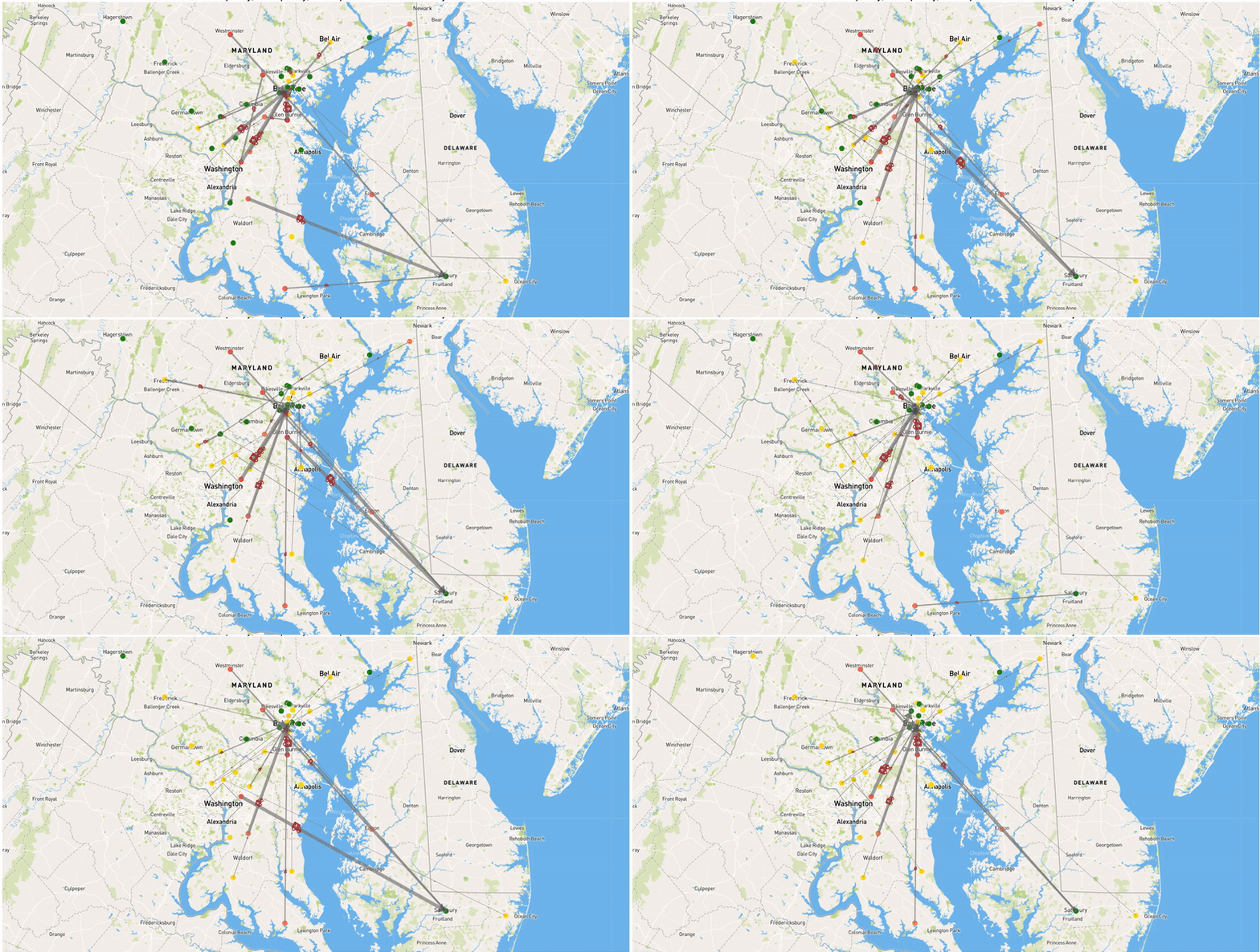
We use mathematical optimization to determine optimal strategies to reduce the burden of COVID-19 on hospitals. In particular, we focus on patient transfers. In practice, hospitals, even those in the same region or system, experience very different COVID patient loads, meaning that some may have unused capacity even while COVID overwhelms other hospitals. Patient transfers can balance these uneven loads and ensure that all capacity to care for patients is efficiently used. Patient transfers were used by some hospital systems that were hit particularly hard during the first wave of the pandemic, but these transfers were generally made reactively as hospitals ran out of capacity rather than planned. Optimal coordinated transfers have potential to significantly help hospitals cope with the burden of COVID and ensure that all patients receive the best possible level of care. We aim to demonstrate the benefits of this approach on this website using real-world data.
Real-Time Scheduling for Outpatient Clinics
Many outpatient facilities with expensive resources, such as infusion and imaging centers, experience surge in their patient arrival at times and are under-utilization at other times. This pattern results in patient safety concerns, patient and staff dissatisfaction, and limitation in growth, among others. Scheduling practices is found to be one of the main contributors to this problem.
We developed a real-time scheduling framework to address the problem, specifically for infusion clinics. The algorithm assumes no knowledge of future appointments and does not change past appointments. Operational constraints are taken into account, and the algorithm can offer multiple choices to patients.
We generalize this framework to a new scheduling model and analyze its performance through competitive ratio. The resource utilization of the real-time algorithm is compared with an optimal algorithm, which knows the entire future. It can be proved that the competitive ratio of the scheduling algorithm is between 3/2 and 5/3 of an optimal algorithm.
This work was performed with the MIT/MGH Collaboration.

Effects on Staffing Patterns on Patient Care

Level-Loading in Primary Care Clinics
Primary care is an important piece in the healthcare system that affects the downstream medical care of patients heavily. There are specific challenges in primary care as healthcare shifts from fee-for-service to population health management and medical home, focuses on cost savings and integrates quality measures. We consider the primary care unit at a large academic center that is facing similar challenges. In this work we focus on the imbalance in workload, which is a growing regulatory burden and directly concerns any staff in primary care. It can result in missed opportunities to deliver better patient care or providing a good work-environment for the physicians and the staff. We consider the primary care unit at the large academic center and focus on their challenge in balancing staff time with quality of care through a redesign of their system. We employ optimization models to reschedule providers’ sessions to improve the patient flow, and through that, a more balanced work-level for the support staff.
This work was performed with the MIT/MGH Collaboration.

Improving Operating Rooms Scheduling Under Uncertainty
An Industry 4.0 Approach to Healthcare Energy Sustainability
Energy Analysis of Healthcare Infection Control Interventions Within Hospitals for COVID-19

Minimizing Secondary Infections in Hospitals
Risk Calculator for C. Difficile Infections at The Hospital Unit Level